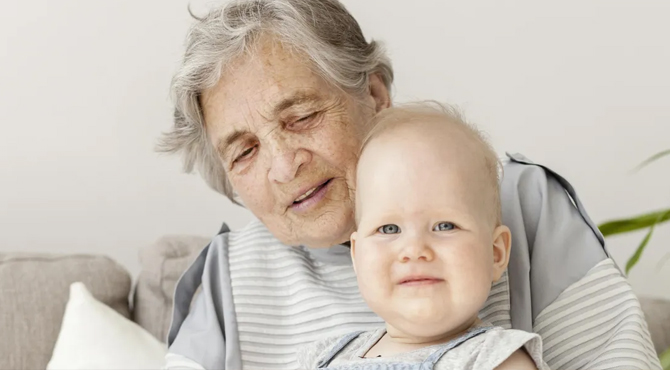
I’m 72 years old now, and if someone had told me a year ago that I would be raising a baby again at this stage of my life, I never would have believed them.
But life has a strange way of unfolding.
Six months ago, my daughter Sarah packed a suitcase while I stood in the kitchen making breakfast. I remember hearing her footsteps on the stairs above me. When she appeared in the doorway holding her two-week-old daughter, Lily, I assumed she was simply taking the baby outside for a little fresh air.
That seemed like the most natural thing in the world.
Instead, she walked quietly into the living room and gently placed Lily into her bassinet, carefully tucking the blanket around her tiny body.
“I’m going to clear my head, Mom,” she said quietly, leaning down to kiss the baby’s forehead.
“Okay, sweetheart,” I replied from the stove as I stirred the oatmeal. “Don’t stay out too long. It’s cold.”
At the time, nothing about the moment felt unusual.
But she never came back.
I didn’t even notice the folded note she had left behind on the counter near the coffeepot. Not until the following morning, when I was cleaning up after another long, sleepless night with the baby.
When I unfolded the paper, my hands started to shake.
The message was painfully short—just a single sentence written in her familiar handwriting.
“Mom, I can’t do this. Don’t try to find me.”
That day I called her phone over and over again.
First twenty times.
Then fifty.
Eventually I stopped counting.
Every call went straight to voicemail.
I contacted the police and filed a missing person report, hoping someone could help. But they explained that Sarah was an adult who had apparently left voluntarily. Unless there was evidence that something bad had happened, there was nothing they could do.
Every polite shrug from an officer felt like another door slamming shut in my face.
After that, I tracked down the baby’s father—a man Sarah had only dated briefly. When he finally answered my call, his tone was cold and distant.
“Look, I told Sarah from the start I wasn’t ready for this,” he said flatly.
“But you have a daughter,” I pleaded desperately. “She needs you.”
“You’re the grandmother,” he replied. “Handle it.”
And just like that, the line went dead.
When I tried calling again, I discovered he had blocked my number.
So this is my life now.
At three in the morning, I rock a baby back and forth in the dim light of the living room.
By noon, I sit at the kitchen table counting pennies.
I used to imagine retirement differently. I pictured leisurely book club meetings, garden parties with friends, maybe even taking a cruise with the other widows from my church.
Instead, I now know the exact price of diapers at every store within a ten-mile radius. I compare formula brands down to the last cent.
My income comes from my late husband’s pension and the small savings we spent our entire lives building. Every month that savings account shrinks a little more.
Some nights I warm up a can of soup for dinner and remind myself that Lily doesn’t know the difference between expensive formula and the store-brand version.
She’s healthy.
That’s what matters.
A few weeks ago, I had one of those days when everything felt heavier than usual.
My back ached from carrying Lily around the apartment all morning. The kitchen sink had started leaking again, and I knew I couldn’t afford to call a plumber. The washing machine had begun making that awful grinding sound—an unmistakable sign it was probably about to give out. Replacing it was completely out of the question.
On top of that, we were completely out of diapers and baby food.
So I bundled Lily carefully into her carrier, pulled on my old winter coat, and headed for the grocery store.
The cold November air hit us the moment we stepped outside. I wrapped my coat tighter around both of us and whispered softly to her.
“We’ll be quick, sweetheart. Grandma promises.”
Inside the store, chaos greeted us immediately.
Holiday music blared loudly from the speakers. Shoppers crowded every aisle, arguing over discounted turkeys and pushing carts overflowing with groceries. I tried to move quickly through the crowd and headed straight for the baby food aisle.
It felt as if the entire world was preparing for celebration and joy while I was simply trying to survive the week.
Every cheerful holiday jingle made the knot in my stomach tighten a little more.
I grabbed several jars of baby food, a small pack of diapers—since the larger package was too expensive—and one small piece of turkey breast. I wanted us to have something nice for Thanksgiving, even if it was just the two of us sitting at my tiny kitchen table.
When I reached the checkout line, I forced myself to smile politely at the young cashier. He looked exhausted, as if he would rather be anywhere else in the world.
I placed my items on the belt and slid my card into the reader.
Beep.
Declined.
My stomach flipped violently because that had never happened before.
Maybe the pension deposit hadn’t cleared yet, I thought.
Maybe I miscalculated after paying the electric bill last week.
I tried again, my hand trembling slightly.
Beep.
The same result.
“Um, could you try one more time?” I asked the cashier nervously.
Behind me, a man groaned loudly.
“Oh, for God’s sake. What is this, a charity line?”
I muttered an apology and fumbled with the card again. My hands were shaking now.
Lily began fussing inside her carrier. Her small whimpers quickly turned into full cries.
I gently bounced her while whispering close to her ear.
“Shh, it’s okay, baby. We’ll figure it out. Grandma will figure it out.”
Then another voice cut through the noise of the store.
A woman somewhere further down the line said sharply, “Maybe if you spent less time having kids you can’t afford, you wouldn’t be holding up the line.”
Her friend laughed cruelly.
“Yeah, seriously. Or at least buy what you can actually pay for. People like this make me sick.”
My cheeks burned with humiliation.
I wished the floor would simply open up and swallow me whole.
With shaking fingers, I opened my purse and pulled out every crumpled bill and coin I could find.
Eight dollars.
That was all I had.
“Could you just ring up the baby food?” I asked the cashier quietly. “Just the baby food, please.”
And then I heard a deep, steady voice behind me.
“Ma’am. You—with the baby.”
For a moment, I assumed someone else was about to humiliate me.
My heart pounded as I slowly turned around, my eyes almost closing as I braced myself for more cruel words.
But the expression on the man’s face wasn’t what I expected.
He looked to be in his mid-thirties and wore a long black coat over a dark suit. He seemed like someone who belonged in a downtown office building—not standing in a crowded grocery store line beside an exhausted elderly woman holding a crying baby.
He lifted his hands slightly, palms facing outward.
“Please don’t be upset,” he said gently.
Before I could even respond, he stepped past me and addressed the cashier directly.
“Cancel her order, please. Ring everything up again.”
The cashier blinked, confused.
“Sir, I don’t—”
“Please,” the man repeated calmly but firmly. “Just ring it all up again.”
The cashier shrugged and began scanning my items again.
The man calmly took out his wallet and tapped his card against the reader before I even had time to understand what was happening.
Beep.
Approved.
For a brief moment, the store seemed to fall silent.
Then murmurs spread through the line.
A man further back scoffed loudly.
“What, you gonna pay for all of us too, hero? Want a medal?”
Someone else laughed.
“Yeah, maybe he’s running a charity now.”
The man turned slowly toward them. His face remained calm, but his voice carried authority.
“You know what’s really sad?” he said. “You all stood here and watched an elderly woman struggle to pay for baby food. Instead of helping or even just staying quiet, you mocked her. You made her feel small.”
He paused before finishing.
“If that were your mother standing here, how would you feel?”
The entire line fell silent.
No one met his gaze.
Even the woman who had insulted me stared down at her shoes.Footwear
The cashier suddenly seemed very interested in the register screen.
My face burned again—but this time not from shame.
Shock.
Gratitude.
Something deeper I couldn’t quite name.
“Thank you,” I whispered, my voice breaking. “Thank you so much. I don’t know how to—”
He smiled gently.
“You don’t need to thank me, ma’am. Just take care of your little one. That’s all that matters.”
By then Lily had stopped crying, almost as if she could feel the calm that had settled around us.
I gathered my bags with trembling hands, still trying to process what had just happened.
I waited near the store exit while he finished paying for his own groceries.
When he walked outside, I lightly touched his arm.
“Please,” I said quickly. “Give me your number or your email. I’ll transfer the money to you as soon as I can. I have it, I promise. I think something’s just wrong with my card, or maybe the deposit—”
He shook his head firmly.
“No need for that. Really, there’s no need.”
Then his voice softened.
“My mother passed away two months ago. You remind me of her.”
He paused briefly.
“Please don’t offer to pay me back. I have more than enough money. It makes me feel better to do something good in her memory. It helps.”
Tears filled my eyes.
I hadn’t experienced that kind of genuine kindness in a very long time.
He noticed me struggling to adjust Lily’s carrier on my shoulder.
“At least let me drive you home,” he offered.
My first instinct was to refuse. I had always been taught never to accept rides from strangers.
But my legs were exhausted, and the bus stop was a twenty-minute walk away. I had stopped by the store after Lily’s doctor appointment, and getting home would require several transfers.
“I don’t want to bother you,” I said softly. “You’ve already done so much.”
“You’re not bothering me,” he replied kindly. “Please. Let me help.”
His name was Michael, I learned as we walked to the parking lot.
His car was sleek and expensive—the kind I’d only ever seen in magazines. He carefully loaded my groceries into the trunk and then surprised me by pulling a child safety seat from the back.
“Here, let me buckle her in properly,” he said.
I hesitated for only a moment before handing Lily to him.
He secured her into the seat quickly and checked the straps twice.
“You have kids?” I asked as he started the car.
He nodded.
“Yeah. Two. My little girl just turned three, and my son is seven. They keep us very busy.”
I smiled despite my exhaustion.
“You must be a good father.”
He chuckled softly.
“I’m trying to be. Some days are better than others.”
During the drive, he asked about Lily.
His genuine interest made me open up more than I expected. I told him everything—about Sarah leaving six months ago, about the note on the kitchen counter, about the endless sleepless nights.
I even admitted how I stretched my husband’s pension and how sometimes I had to choose between paying the electric bill and buying the larger pack of diapers.
He listened without interrupting once.
“You must be completely exhausted,” he said finally. “Let me help you properly. I mean, I could hire you a nanny. Someone good, someone trustworthy with excellent references.”
I shook my head quickly.
“No, I couldn’t possibly do that. I can’t afford—”
“You wouldn’t have to pay,” he interrupted gently. “I’ll cover it. All of it. In memory of my mom. She would have wanted me to help someone who needed it.”
But I refused again.
“You’ve already done enough. More than enough. Really.”
He didn’t push the matter any further.
When we reached my apartment building, he insisted on carrying my groceries upstairs.
I thanked him again at my door, certain that I would never see him again.
People like him didn’t remain in the lives of people like me.
But the next afternoon, my doorbell rang.
When I opened it, Michael stood there with a woman who was clearly his wife and two beautiful children. He held a pie dish in one hand, steam still rising from it.
“We came to invite you and Lily to Thanksgiving dinner tomorrow,” he said warmly. “And my wife brought something for you.”
His wife stepped forward with a friendly smile.
“Hi, I’m Rachel,” she said. “Michael told me about you and everything you’re going through.”
She handed me a small folder.
Inside were photos and detailed profiles of several professional nannies, complete with references and experience notes.
“We thought you might want to choose someone yourself,” Rachel said kindly. “Someone you feel comfortable with.”
I couldn’t speak.
Tears spilled down my cheeks before I could stop them.
That Thanksgiving turned out to be the warmest holiday I had experienced in years.
Their home was full of light, laughter, and warmth. They treated me like family—as if I truly belonged there.
Their children played with Lily, making funny faces and waving colorful toys to coax her first real smiles.
A few days later, Michael brought up the nanny again.
And this time, I finally accepted.
Her name was Patricia.
She was wonderful.
For the first time since Sarah left, I could rest.
I could breathe again.
Sometimes I still think about that day in the grocery store.
About how the cruel voices of strangers slowly faded into background noise—and how one stranger became family.
And every Thanksgiving since then, I bring a homemade pie to Michael and Rachel’s house.
Just like the one they brought to mine that very first time.