I’ve taken hundreds of emergency calls, but nothing prepares you for a child whispering as if they’re trying not to be heard. That night, a five-year-old told us someone was hiding under her bed. We thought it was fear. We were wrong. And what I saw when I looked under there still stays with me.
The Call That Felt Different
After 10 years in the service, I know the difference between panic and imagination. Children call about all kinds of things: a barking dog, a strange shadow on the wall, or a monster under the bed. Most of the time, fear grows bigger in the dark.
But that night, the voice coming through the line did not sound like a child inventing monsters. It sounded like a child trying desperately not to let one hear her.
The dispatcher patched the call through while I was still shrugging on my jacket.
“My parents aren’t home,” the girl whispered. “They went to a party. Someone is hiding under my bed. Please help me. Please come…”
“Sweetheart, what’s your name?” the dispatcher pressed.
“Mia.”
“Okay, Mia. I need your address.”
There was a pause. I could hear her breathing. Then came a faint rustling sound, like fabric dragging over the floor.
“I don’t know it,” Mia whispered. “Wait… Mama has a box in her room from the courier.”
The dispatcher looked at me and mouthed, “She’s alone.” That changed the entire feeling of the call.
We listened as Mia padded across the floor, carefully reading the label one number at a time.
“Three… one… seven… Willow Lane…”
“You did great,” I said. “Stay where you are. We’re coming.”
Then Mia added something that immediately unsettled me.
“My nanny was here. But she’s not here now.”
My partner, Luis, glanced over. “That better have a simple explanation.”
I stared out at the rain-slicked streetlights passing by the cruiser window. “Let’s hope it does.”
The House on Willow Lane
Willow Lane was one of those perfectly quiet suburban streets where every porch light seemed deliberately placed. Mia’s house was large, pale blue, and unnervingly still.
Not the kind of stillness that feels peaceful.
The kind that makes you wonder what might be happening behind the windows.
Before we even knocked, the front door slowly cracked open.
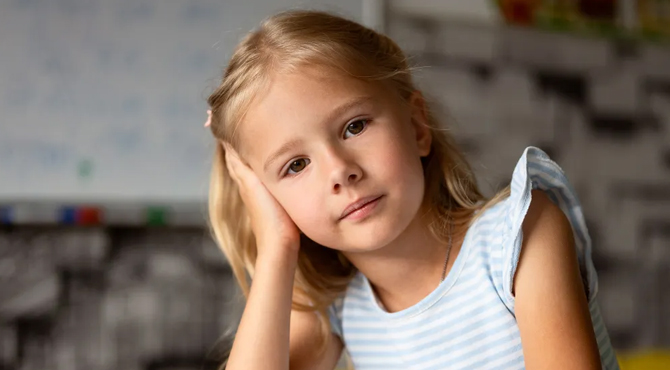
A little girl in pink pajamas stood there clutching a worn teddy bear so tightly that one of its ears bent beneath her fingers. Her hair was tangled from sleep, and her lower lip trembled even though she was clearly trying with all her strength to keep it steady.
“My name is Mia,” she said softly. “Please come. There’s someone under my bed. I’m really scared.”
I crouched down so I wouldn’t loom over her.
“You did exactly the right thing calling for help.”
Mia nodded, but her eyes kept darting toward the staircase.
Our counselor, Dana, knelt beside her while Luis and I searched the house. Every room we checked was spotless, silent, and empty.
Nothing seemed wrong.
And somehow, that made the situation feel even heavier.
Mia’s bedroom sat at the far end of the hall. It was small and cozy, with moon-shaped lights hanging near the window and dolls carefully lined across a shelf. Her blanket was twisted halfway off the mattress, as though she’d climbed out of bed too fast to think.
I checked the closet.
Behind the curtains.
The bathroom.
Nothing.
Luis came upstairs and shook his head.
“Clear.”
He crouched beside Mia in the hallway.
“Sweetheart, it was probably just a scary sound. You’re safe. We’ll call your parents and they’ll be home soon.”
Mia’s face immediately crumpled.
“You didn’t look under the bed!”
Honestly, I thought checking there would just be a formality. The house was already clear.
But a frightened five-year-old deserves the courtesy of being believed all the way through. If a child tells you where the fear lives, you don’t stop one inch short of that place simply because everything else makes sense.
“Okay,” I told her. “I’ll check.”
Mia tightened her grip on the teddy bear.
“Please, really look.”
“I will.”
The Eyes Beneath the Bed
I went back into the room alone and lowered myself onto one knee beside the bed.
Something still didn’t feel right.
At first, all I could see was darkness.
Dust near the baseboard.
A dropped sock.
The corner of a board game box.
Then I heard it.
A faint sound.
Not a growl.
Not a scrape.
Just the slightest catch of breath, like someone trying with everything they had to remain perfectly still.
Every muscle in my back locked instantly.
“Oh my God,” I said before I could stop myself.
Because tucked tightly against the wall beneath Mia’s bed was not a shadow.
Not a stranger.
It was another little girl.
She was curled onto her side, trembling beneath a thin yellow sweater. Her large frightened eyes stared back at me from the darkness.
“Luis,” I called. “I need you in here.”
Luis appeared in the doorway. I lifted the bed skirt higher.
He froze.
“You’ve got to be kidding me.”
The little girl flinched.
I immediately softened my voice.
“Hey. It’s okay. You’re safe. Can you come out for me?”
She didn’t answer.
Instead, she pressed herself farther into the corner.
When I carefully reached toward her, I could feel heat radiating from her before my fingers even touched her sleeve.
“She’s burning up,” I said.
Together, Luis and I gently eased the girl out from beneath the bed. She was smaller than I expected, limp with fear and fever.
Dana stepped into the room, saw the child in my arms, and stopped cold.
For one brief second, nobody spoke.
None of us had expected to find another child hiding there.
Then Mia gasped from the hallway.
“That’s the girl.”
The Silent Child
We carried the girl downstairs and settled her carefully onto the couch.
I crouched in front of her and started with the simplest questions.
“What’s your name?” I asked gently.
The girl said nothing.
“Can you tell me where your mom is?”
Still nothing.
Her eyes moved from my face down to my hands.
Then she raised her fingers and began signing rapidly.
Dana noticed first.
“Kevin, she uses sign language.”
The girl’s hands moved even faster when she realized we didn’t understand her. Not wildly.
Urgently.
Like she was trying to climb over a wall built from our confusion.
Dana knew enough sign language to catch fragments.
“Scared. Bed. Hid. Girl moved. She hid.”
Mia stepped a little closer.
“I dropped Teddy. When I bent down, I saw her eyes looking at me.”
No wonder the poor child had panicked.
The girl signed again before suddenly pointing toward the front door.
I followed her gesture.
“Someone outside?”
She nodded, then shook her head in frustration.
Luis muttered under his breath.
“We’re missing something.”
The girl climbed off the couch, still wrapped in a blanket, and hurried toward the entryway. She pointed repeatedly at the door.
And for one deeply uneasy second, the tension inside the house rose all over again.
Because we still had no idea how she had gotten there.
Then the front doorknob turned.
The Truth About Polly
A woman burst inside carrying a small pharmacy bag.
The moment she saw the little girl standing by the door, everything else disappeared from her face.
“Polly!” she screamed.
The child ran straight to her and wrapped herself around the woman’s legs.
The woman collapsed to her knees and pulled Polly tightly into her arms, covering the top of her head with frantic kisses.
Then she looked up at us.
At Mia.
At the blanket.
And I watched the truth slowly settle across her face.
“Oh no,” the woman whispered.
“You’re her mother?” Dana asked.
“Yes. I’m Marisol. I’m Mia’s nanny.”
Mia looked between us and asked quietly,
“You left me, Miss Marie?”
Marisol’s eyes instantly filled with tears.
“I only went to the pharmacy nearby, sweetie. Polly was burning up, my mother was out of town for a funeral, and I had no one else. I brought her with me. Since you were already asleep in your room, I told Polly to stay in the kitchen. She can’t talk, she uses sign language, so I thought she’d stay put. I told her I’d be right back.”
“And your daughter wandered upstairs,” Luis said.
Marisol covered her mouth.
The explanation came quickly, but it did not erase the fact that both children had been left alone.
I looked directly at her.
“You left two children alone in this house.”
Marisol lowered her eyes.
“I know… I’m sorry. The pharmacy was just on the next block, and I thought I’d be back before Mia even noticed I was gone.”
“Do you understand what could have happened here?” I snapped.
Tears gathered along her eyelashes.
“Yes.”
Behind me, Mia spoke softly.
“I thought someone bad was under my bed.”
Marisol looked completely stricken.
“I’m so sorry, sweetheart.”
Once Polly had taken her medicine, the rest of the story slowly came together.
Polly had wandered upstairs after noticing Mia’s dolls. When Mia moved in bed, Polly panicked and hid beneath it.
Mia woke up, dropped her teddy bear, bent down to grab it, and saw a pair of eyes staring back at her from the darkness.
The Brave Little Girl
Mia first searched the house for Marisol, moving from room to room through the empty silence.
Then she remembered something her father had once told her after a break-in happened nearby.
“If you’re scared and you need help fast, you call 911.”
So she did.
Looking at that little girl, I felt something close to admiration settle in my chest.
Mia was only five years old.
She was alone.
Terrified.
And she still acted.
I crouched in front of her.
“You did everything right tonight.”
Her lip trembled.
“Really?”
“Really. Because you made that call, both you and Polly are safe.”
She looked up at me uncertainly.
“I thought maybe I’d get into trouble.”
“No,” I said firmly. “You were smart.”
Marisol quietly cried at that, probably from relief, guilt, or both.
I asked for Mia’s parents’ numbers and called them immediately.
They arrived home less than thirty minutes later.
Car doors slammed outside.
Then came hurried footsteps.
Mia’s mother rushed through the door first, her face completely drained of color, with her father right behind her, tie crooked and eyes searching wildly until they landed on their daughter.
“Mia!”
The little girl ran straight into their arms.
Her mother dropped to the floor and hugged her so tightly that Mia squeaked.
Anger, Relief, and Mercy
I told Mia’s parents the full truth.
By the time I finished explaining, Mia’s mother had gone from relieved to furious.
She turned sharply toward Marisol.
“You left her alone?”
Marisol clutched the pharmacy bag like it was the only thing keeping her upright.
“I’m sorry. Polly was sick, and I thought…”
“You thought wrong,” Mia’s father snapped.
For a moment, it genuinely looked as though Marisol was about to lose everything.
Polly sat on the couch watching with wide, miserable eyes.
That was when I stepped in.
“It was a serious mistake,” I said. “But it wasn’t deliberate. She was trying to get medicine for a feverish child with no backup. That doesn’t excuse it. It explains it.”
Mia’s father looked at me tightly.
“So what are you saying?”
“Be angry,” I told him. “You should be. But think before you throw everything away tonight.”
Silence filled the room.
Finally, Mia’s father turned toward Marisol.
“This can never happen again.”
She nodded immediately.
“It won’t.”
“If you ever leave our daughter alone again,” he warned, “you won’t be coming back.”
“Understood,” Marisol whispered.
Dana quietly brought both girls into the dining room with coloring books while the adults settled themselves.
When I walked in later, Mia was coloring a house with a purple roof while Polly leaned sleepily against her mother’s coat.
The two girls had already moved on in that quiet, resilient way children sometimes do while adults remain trapped in the sharp edges of a moment.
The Lesson I Never Forgot
I sat beside Mia.
“How are you feeling now?”
“Better,” she answered.
Then she added with complete seriousness,
“I still don’t like eyes under my bed.”
That made me laugh.
And thankfully, it made her laugh too.
Before we left, I knelt one final time so we were eye level.
“Mia, you were brave tonight. You got scared, but you still thought clearly. That’s a big deal.”
She looked at me carefully.
“Even though I was whispering?”
“Especially because you were whispering. You stayed calm enough to ask for help.”
Her father rested a hand on my shoulder.
“Thank you.”
I shook my head.
“Thank your daughter, too. She did her part.”
On the way out, Luis released a long breath.
“If we hadn’t checked under that bed, I’d never have forgiven myself, man.”
“Neither would I,” I replied.
That night stayed with me, not because of what we found, but because a five-year-old knew something wasn’t right and trusted herself enough to speak up.
She was alone.
Scared.
Whispering.
And she still made the call.
Sometimes the bravest thing you can do is believe a child the first time she says, “Please help me.”
Note: This story is a work of fiction inspired by real events. Names, characters, and details have been altered. Any resemblance is coincidental. The author and publisher disclaim accuracy, liability, and responsibility for interpretations or reliance. All images are for illustration purposes only.