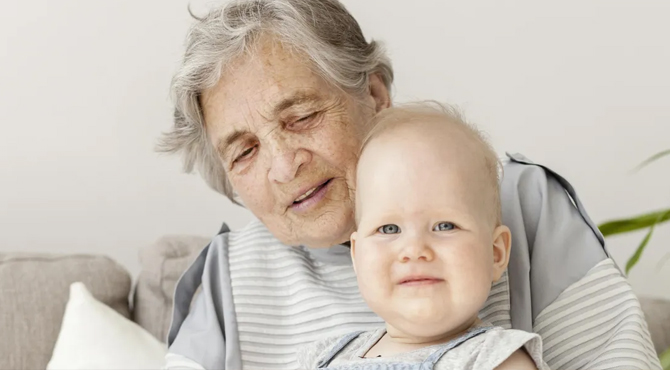
I found a baby boy lying beside my rose bushes, wrapped in soft blue blankets with a note asking me to give him a good life. At first, I thought someone had trusted me with something precious. But the very next day, the footage from my security camera revealed the truth—and it shattered my family forever.
I always believed roses were simpler than people.
If a rose needed water, it wilted. If it was diseased, it showed signs. And if something rotten threatened the roots, you cut it away before it spread.
People, though… people could be starving for love and still smile across the breakfast table.
That thought was lingering in my mind the morning I found the baby.
It was just before seven. I was outside in Mark’s old gray robe and my gardening clogs, holding pruning shears in one hand and a cup of coffee in the other. The air still carried a soft spring chill, and my yellow roses were beginning to bloom.
I’d named that bush “Sunny.” At forty-nine, I had no shame in loving my plants like family.
“Looking dramatic today, aren’t we?” I muttered as I clipped away a dead leaf.
That’s when I noticed the blue bundle.
It lay beside the rose bed, close to the porch light—not tossed aside, not hidden, but placed carefully, as if someone wanted it to be found.
At first, I assumed it was just a blanket. People left strange things in yards all the time.
Then it moved.
My coffee slipped from my hand and hit the porch.
“Oh my God!”
I rushed forward so quickly I lost one of my clogs. The bundle was wrapped in faded blue blankets. A small knit hat peeked out from the top.
With trembling fingers, I pulled the blanket back.
A baby boy.
He couldn’t have been older than six months. His cheeks were flushed from crying, his tiny fists curled beneath his chin.
“Oh, sweetheart,” I whispered, dropping to my knees. “You’re okay. I’ve got you.”
Pinned to the blanket was a torn piece of paper:
Please, give him a good life.
I can’t.
I love you, baby boy.
I stared at the note, stunned. Then he whimpered again, and instinct took over. He was strapped into a clean infant carrier, with a bottle and an extra hat tucked beside him.
Whoever left him… wanted him safe.
“Okay,” I said softly, lifting him. “Let’s get you warm.”
I carried him inside.
“Mark!” I shouted. “Come downstairs!”
My husband appeared moments later, tying his robe, still half-asleep.
“Lynn, what’s going on?”
Then he saw the baby—and all the color drained from his face.
“Where did you get that baby?” he asked.
“I found him outside. Call 911, Mark.”
“No.”
I blinked. “What?”
“No, Lynn. We need to hand him over and stay out of this.”
“He was left in our yard. We’re already involved.”
“Then don’t get attached.”
“He’s a baby, Mark.”
The baby began to cry harder.
“Get a towel,” I said. “And warm the bottle.”
Mark didn’t move.
“Mark?”
“This isn’t our problem.”
I stared at him. “You haven’t even asked if he’s okay.”
He hesitated, then looked away.
That was the first crack.
I called 911 myself.
Paramedics arrived quickly. The baby was cold and hungry, but stable. They said they’d take him to the hospital for a full check.
I felt my shoulders sag in relief.
“Do you know who left him?” the officer asked.
“No,” Mark said too quickly. “We have no connection to this child.”
No connection.
It sounded rehearsed.
“Do you have cameras facing the yard?” the officer asked.
“No,” Mark answered.
“Yes,” I said at the same time.
We locked eyes.
“I’ll review the footage,” I added.
As the paramedic carried the baby away, his tiny fingers wrapped around mine.
“We don’t even know his name,” I whispered.
At the hospital, they confirmed he was healthy.
“Someone wanted him found,” the nurse told me gently. “He’s loved, even if they couldn’t keep him.”
Mark texted me: Come home. Don’t make this personal.
I replied: It already is.
When I got home, Mark was waiting in the kitchen.
“You lied about the camera,” I said.
“I forgot,” he snapped.
“You don’t forget something you check every night.”
“I was stressed!”
“So was the baby.”
He said nothing.
That was the second crack.
That night, I barely slept.
Around four in the morning, I heard Mark get up and quietly shut his office door.
By sunrise, he was gone. He left a short note:
Meeting. Back late.
No goodbye. No concern.
I threw the note away.
Then I opened the camera footage.
At 6:14 a.m., a car stopped outside. A young woman stepped out, carrying the blue bundle.
I leaned closer to the screen.
She moved carefully, gently placing the baby beside my roses.
“Okay, Ollie,” she whispered. “Just a little longer. She’s kind. I’ve been watching her… she loves her roses.”
She kissed his forehead.
Then she whispered a word that made my blood run cold.
“Dad.”
The front door opened.
Mark stepped outside.
He wasn’t surprised.
He was angry.
“Gabrielle,” he hissed. “I told you not to come here.”
She held out a piece of paper. “Please, give this to Lynette.”
“No.”
“He’s your grandson.”
My hand flew to my mouth.
Mark snatched the paper. “Leave.”
“She deserves to know!”
“She knows nothing,” he said coldly. “And it’s staying that way.”
Then he walked back inside.
The baby had been outside for thirteen minutes.
Thirteen.
My hands shook as I saved the footage and sent copies to myself, the police, and my sister.
Then I went into Mark’s office.
In twenty years of marriage, I had never searched his things.
That morning, I did.
In a drawer, I found bank statements.
Payments labeled:
Susan – Rent
Gabrielle – Tuition
Gabrielle – Phone
Oliver – Medical
“Oliver,” I whispered.
Behind them was an email.
I’m not asking you to love me, Mark. I’m asking you to help our daughter. Help our grandson.
His reply:
Don’t come to my house. My wife knows nothing.
When Mark came home, I was waiting.
I played the footage.
He watched everything unfold in silence.
“I was going back,” he said weakly.
“You went upstairs.”
“I panicked.”
“No. She panicked. You chose silence.”
He broke. “It was before you.”
“Your affair was before me. Your daughter existed during our marriage. You lied for twenty years.”
“I sent money—”
“You abandoned them.”
“I was trying to keep peace.”
“No. You were protecting yourself.”
He had no answer.
I called Gabrielle.
When she answered, her voice was guarded.
“If you’re calling to blame me—”
“This is Lynette.”
Silence.
Then, softly: “Is he okay?”
“Oliver is safe.”
She broke down crying.
I found her at a diner near the bus station.
“He said you wouldn’t want me,” she whispered.
“Then he never knew me,” I said.
She had been watching from a distance, afraid.
“I’ll help you,” I told her. “You don’t have to do this alone.”
The following Sunday, Mark gathered his family to “explain.”
I let him speak.
Then I opened the door.
Gabrielle walked in, holding Oliver.
“This is Mark’s daughter,” I said calmly. “And his grandson.”
When he tried to discredit her, I played the footage.
Silence filled the room.
“Twenty years?” his sister whispered.
No one defended him.
No one moved.
Gabrielle received support, and Oliver stayed safely with her.
I filed for separation.
At the door, Mark said, “I kept this family together.”
I looked at him steadily.
“No,” I said. “You only kept your image together. The real family was outside all along.”
Months later, Oliver reached toward my yellow roses.
I gently pulled his hand away from the thorns.
Mark thought the truth destroyed our family.
But the truth doesn’t destroy anything.
It only reveals what was already broken.